
Article: When your dog won't eat
When your dog won't eat
When Umi was about eighteen months old, she started leaving food.
She had always emptied the bowl. All of a sudden, she'd eat about half and walk away. The next day she'd finish it. The day after that, half again. I worried something was wrong, but she was energetic, and she still wanted her walks.
In Umi's case, I later learned that something wasn't wrong with her body. It was how I was serving her food.
But there is a reason behind when dogs refuse to eat, and the reason changes what you should do. Sometimes it's the body. Sometimes it's the food. Sometimes it's the shape of the bowl, or a hotel room.
Below are the possible causes, in the order worth checking them.
First, rule out illness
Appetite is often one of the earliest indicators of how a dog is feeling. So the first thing to suspect is not preference, and not environment. It's the body.
If you notice any of the following, don't wait and see. Talk to your vet early.
-
Nothing eaten for more than 24 hours
-
Not drinking water either
-
Accompanied by vomiting or diarrhoea
-
Lethargic, or breathing heavily
-
Dislikes being touched somewhere on the body
-
Tries to eat, but drops the food from their mouth
That last one may be easy to miss. Periodontal disease and pain in the mouth look almost identical to "no appetite" from the outside. The dog approaches the bowl as if they want to eat, and then doesn't. When that happens, have a look inside their mouth too.
Also worth remembering: puppies and senior dogs are said to be more vulnerable when they go without eating. An adult dog skipping one meal is rarely a serious problem, but at those two life stages in particular it's safer to check with a vet early.
Has the food gone stale?
Something that's surprisingly easy to overlook is the condition of the food itself.
Dry food begins oxidising the moment the bag is opened. The fats meet air, degrade, and the smell changes. At a stage where a human nose notices nothing, your dog may already have noticed. Their sense of smell simply operates on a different order.
Things to check:
-
Has it been more than a month since opening?
-
Are you folding the bag over and using a rubber band?
-
Is it stored in direct sunlight, or next to the stove?
-
Did you buy a large bag that takes a long time to get through?
Large bags look cheaper. But if the last third doesn't get eaten, they may end up costing you more. Seal it properly after opening, and buy a size you can finish in a month. Sometimes that alone really does solve it.
Humidity matters too. "One month from opening" is only a guide; through the rainy season, or somewhere damp like Karuizawa, it can go off a little faster. Through the summer we keep food in a sealed container, up on a shelf rather than on the floor. The closer to the floor, the more moisture collects.
If you're unsure, open the bag and check the smell. If it smells of old oil — like a pan that's been used for frying too many times — it may already be oxidising.
Are there too many treats?
They won't eat, so out of worry you give them a treat. The treat fills them up, so they don't eat their meal. You worry again, and give another treat.
I suspect quite a few households are in this loop.
Treats are highly palatable and strongly flavoured, as a category. Once a dog has learned that, putting a mildly flavoured main meal second is, if anything, a reasonable decision on their part.
Try pausing treats for a week or so. If they start eating their meals again, the reason may be habit rather than health.
Are you serving it in a form they can pick through?
Back to Umi.
At the time she suddenly started leaving her food, we were feeding her something close to home-cooked. The main contents were raw salmon and steamed sweet potato, served sitting next to each other in her bowl. For months, she happily ate this.
Then, she was eating the salmon and leaving the sweet potato.
So it wasn't that she had no appetite. She was choosing. If the food arrives in separable parts, a dog can choose. I had set it up so she could choose, and then worried that she wasn't eating all of it.
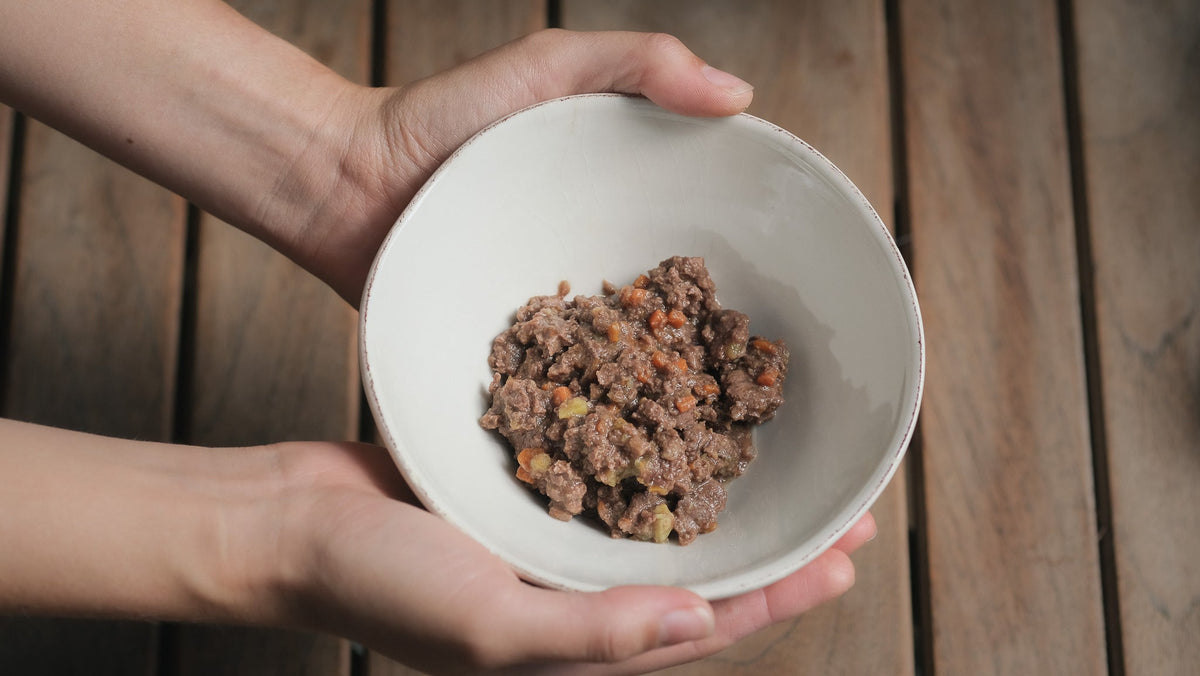
What we did was simple. I started cooking her food, and mixed it properly together before giving it to her.
Once it's one thing, it smells like one thing. It becomes harder to pick things out by the smell of the salmon alone. From that point on, Umi ate all of it.
(It was around this time that our kitchen started using venison. Karuizawa Harvest began there.)
Her age may have played a part too, looking back. The puppy phase of eating anything at all ends, and preferences sharpen. It's a stage of growing up, not a sign that something is wrong.
Preferences do vary from dog to dog. In a 2018 study at the University of Bern, sixteen dogs were repeatedly offered a choice between their usual food and a different one: six preferred the change, six preferred their usual food, and four showed no clear preference either way (Bremhorst et al., 2018).
There's more to this. The same goes for toppers, which I'll come to later. Left sitting on top, a dog will sometimes eat that and leave what's underneath. Stirred through, they often eat better.
Where they eat, and what they eat from
Appetite responds to the environment, too.
-
The bowl is at the wrong height. Large and senior dogs in particular can strain their neck and forelimbs with a bowl placed directly on the floor
-
It sits in the middle of where people walk. They may not be able to settle
-
In a multi-dog household, another dog is watching while they eat
-
Something loud, like a washing machine or vacuum cleaner, is nearby
Sometimes it's the bowl itself. Umi doesn't eat well from a large metal one. I think it's the noise it makes when it shifts, and the way the inside catches the light when she puts her face in. Same food, different bowl, and they eat. That really does happen.
Try raising the bowl a few centimetres. Try a quiet corner against a wall. Try a different material. A change that small can sometimes be enough.
When they won't eat away from home
You arrive at the hotel, and they eat nothing that evening. Nothing the next morning either. It may be the most common thing we're asked about when travelling with a dog.
The reason usually isn't that something is physically wrong with the dog.
It is that the place has changed, the smells have changed, the floor feels different underfoot. The bowl has become a folding travel one, at a different height, making a different noise. There's three hours in the car behind them. And if their owner is tense about the trip, that transmits, and the dog eats less still.
What you can do is keep the number of things that are different from usual as small as possible.
-
Bring the bowl from home. Bulky, but often the single most effective thing you can do
-
Bring their own food, in their usual amount. Don't try something new while away
-
Feed them in a quiet corner of the room. Avoid the side where people come and go
-
Don't panic over a missed meal. An adult dog who is drinking and healthy will usually be back to normal by the second day
Not eating on one overnight trip doesn't mean anything about their constitution or their character. Most dogs are eating normally by about their third trip when they are used to travelling a bit.
Season and temperature
The usual explanation is that dogs eat less in summer. Energy goes into regulating body temperature and activity drops. That can be true.
Living in Karuizawa, though, it doesn't apply much. August at a thousand metres is still relatively cool, and appetites here are, if anything, steady. I hear that dogs arriving from Tokyo start eating better the day after they get here; local hotels tell us this often.
The winters here, on the other hand, are hard. When mornings run below minus ten for weeks at a stretch, an hour's walk becomes twenty minutes. Fewer calories are burned, but staying warm can be hard on the body. Plenty of dogs here eat less or more sporadically through the winter.
Umi, though, eats exactly the same in summer and winter.
So perhaps the season itself isn't the cause. I think it's the individual factors within it, such as temperature and activity level, that make the difference.
Their nose dulls with age
When a dog approaches food, the first sense to engage is said to be smell. Not taste. A 2024 review in the Journal of Food Science reports that dogs evaluate food by smell before they begin eating at all (Calderón, White & Seo, 2024).
And that sense gradually changes with age. Part of the reason appetite thins in a dog's senior years may be not that food has stopped tasting of anything, but that the smell isn't reaching them.
When that happens, warming the food a little is one thing to try.
Aroma compounds lift into the air more readily as temperature rises. It's why food straight from the fridge smells of so little. Bringing it to roughly body temperature changes the smell. With dry food, add a little warm water and leave it a few minutes before serving. There are a great many dogs who start eating with that simple adjustment.
When they still won't eat
You've checked all of the above. Nothing is wrong physically, the food is fresh, the environment is right. And they still won't eat. That is when a topper is one option.
In the US and UK this habit is already established. Rather than changing the food itself, you add a small amount of topping to the usual meal. They call it a "topper," and fresh-food brands have taken it from niche to ordinary over the past decade.
The logic is simple. Smell, moisture, and a change in texture. Those three can sometimes be what gets a flagging appetite going again.
In Japan the term may still be unfamiliar. But stirring in a little boiled vegetable, sprinkling a dog furikake over the bowl — these are all versions of toppers.
A topper doesn't replace the main meal. It's simply a little something added to their usual food, for them to enjoy.
And as I mentioned above, I suggest stirring a topper into the food rather than just putting it on top. Left on the surface, it sometimes gets eaten and the rest gets left. Umi loves her venison topper, which is what inspired Karuizawa Harvest.
Common questions
Should I go to the vet if they've only missed meals for one day?
For an adult dog who is drinking water and otherwise energetic, skipping one meal is usually fine to watch. Puppies, senior dogs, and any dog not drinking water are different — see a vet early.
Can I give treats when they won't eat?
Best avoided if you can. It gets you through the moment, but they can learn that waiting produces a treat.
Can I soften the food with water?
Yes. It lifts the aroma and adds moisture. But softened food spoils quickly; if they haven't eaten it, take it away after about thirty minutes.
Can I use a topper every day?
If you're reducing the main meal accordingly, daily is fine.
They eat only the parts they like and leave the rest.
It's likely arriving in a form they can pick through. If you mix the food together, it is harder for the dog to pick through it.
Finally
When a dog won't eat, it isn't always a sign that something is wrong. It may be their way of telling you something.
In our case the answer was simply to cook and mix Umi's food. A very simple thing. Even so, it took a full round of worrying to get there.
Sometimes it's the body. Sometimes it's the food. Sometimes it's what the bowl is made of, or a room in a hotel. Take it one thing at a time, without rushing, and you'll usually find the cause.
References
Calderón, N., White, B. L., & Seo, H.-S. (2024). Measuring palatability of pet food products. Journal of Food Science.
Bremhorst, A., Bütler, S., Würbel, H., & Riemer, S. (2018). Incentive motivation in pet dogs – preference for constant vs varied food rewards. Scientific Reports, 8, 9756.
We give our dogs' food the same care we give our own. Caring about the flavour of every ingredient, and where it comes from, is at the heart of how Karuizawa Harvest makes its food.