


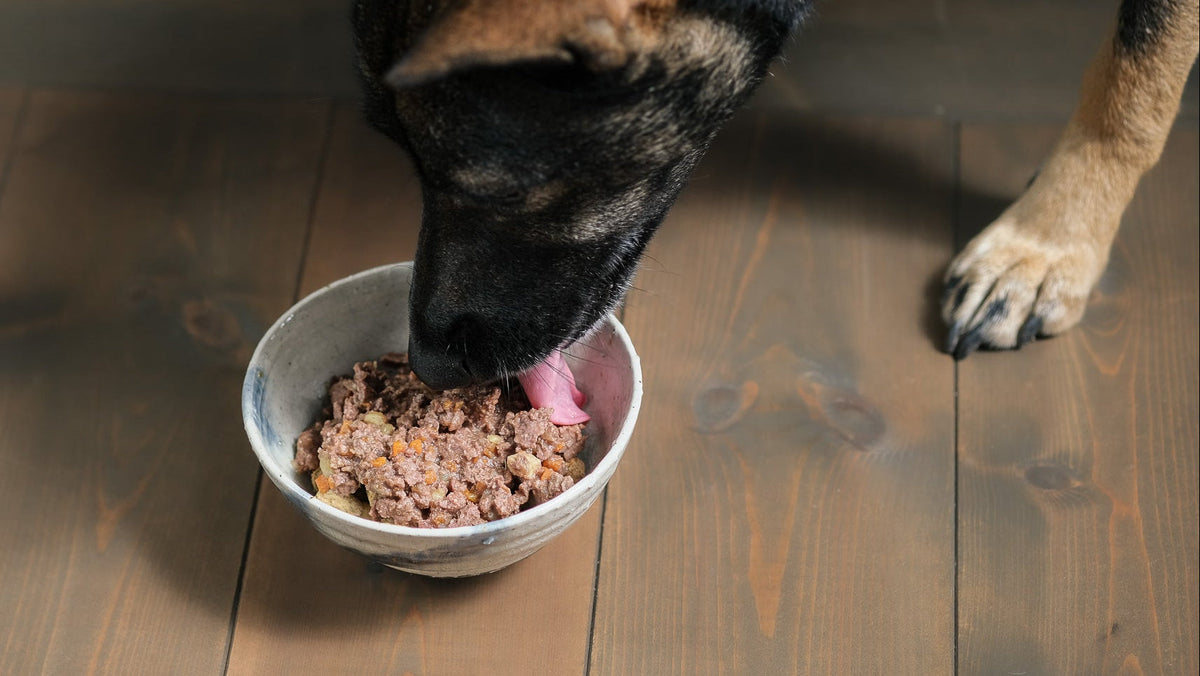
What Is a Meal Topper?
Adding something on top of your dog's usual food is a small thing to do, but it can change how they eat. Their nose starts working before the bowl's even down. Our dog, Umi, does the perfect sit and waits, eyes locked on our hands, until her meal is served.
In the US and UK, this practice of adding to a dog’s base food has a name: a meal topper. Whether it comes as freeze-dried meat, a gravy, a powdered mix, or something you've cooked yourself, a meal topper goes on top of the regular meal rather than replacing it.
An old habit with a new name
If you're feeding a dog in Japan, none of this will feel unfamiliar. Softening dry kibble with a splash of warm bone broth, or spooning over a little home-cooked food, is something many households already do. The word "meal topper" arrived from elsewhere, but the habit itself is already here.
Topper or treat?
The two words get used interchangeably, though they mean slightly different things. A treat is something you give between meals, often as a reward or during training. A topper is served at mealtime, either stirred through the regular food or spooned over the top, and it can also be given on its own as a standalone wet treat. The distinction matters mostly when you're thinking about portions: a topper is meant to complement a meal, not replace it. A treat is a little snack given between meals.
Why dogs respond to meal toppers
Smell, texture and taste all play a part in whether a dog enjoys its food. A 2024 review in the Journal of Food Science suggests smell is what matters first, often before your dog has taken a single bite (Calderón, White & Seo, 2024).
However, not every dog wants the same thing from a topper. A 2018 University of Bern study gave sixteen dogs a repeated choice between their usual food and a varied one. Six went for the variety, six stuck with the consistency of what they knew, and four showed no clear preference either way (Bremhorst et al., 2018). So, like humans, dogs have their individual preference.
For some dogs, what a topper offers isn't something new so much as a familiar food made a little more interesting.
Which dogs benefit most from a topper
While each dog is different, and you should consult your veterinarian about your own dog's specific needs, toppers can benefit a variety of different dogs.
Toppers can entice dogs that have grown fussy or slow about finishing their meals (such as elderly dogs or picky eaters) or help smooth the transition from one type of base food to another.
Some owners choose to incorporate toppers simply because they want to bring more variety into an otherwise consistent diet. Like for humans, food can provide dogs with la joie de vivre.
Examples of meal toppers
Meal toppers come in many different forms and can either be store-bought or home-cooked.
Store-bought
-
Retort-pouch mixes
-
Freeze-dried meat or organ pieces
-
Gravies and broths
-
Powdered mixes you rehydrate with water
Home-cooked
-
Boiled or steamed vegetables
-
Small pieces of plain cooked meat
-
Bone broth, cooled and strained
Whichever you choose, generally meal toppers that have readily-identifiable, high-quality ingredients and few additives can provide the biggest positive impact. Because a topper is a small quantity of food, ingredient quality makes a big difference.
Aromatic ingredients such as organs or natural vegetable and fruit sugars can be particularly appetising.
How to serve a topper: size and temperature
A topper should stay a small proportion of the meal, typically a spoonful to a small fistful depending on the size of your dog. Think of it as an addition, not a second meal.
Temperature matters more than you'd expect. Most dogs enjoy a topper best at room temperature. Toppers straight from the fridge or heated too much can lose some of the aroma that draws your dog to it.
Introducing a topper for the first time
If you're trying a topper for the first time, it is recommended to introduce it gradually over several meals rather than adding a full portion straight away. Start with a small amount alongside your dog's usual meal and watch how they respond over the first few days. As always, it can be useful to consult your veterinarian if you have questions specific to your dog.
Once opened, most toppers keep better refrigerated and are best used within the window stated on the packaging.
Building a topper into your routine
In practice
Most owners find it easiest to add a topper at the same meal each day, so it becomes part of an existing pattern rather than a new decision every time. For example, you can add a meal topper to each breakfast, each dinner, or to both meals every day.
In our own routine
We add a meal topper to every meal for our dog, Umi. She eats freeze-dried food as her base, and we add our wet mix of wild venison meat, heart and liver, Shinshu apple, carrots, sweet potato and broccoli. Once we've stirred it through, the liquid from the topper helps soften her dry food.
Umi is always sitting and impatiently waiting for her food by the time we are mixing the topper in. When we put it down, she enthusiastically eats it and then licks the bowl clean. She even comes back to the empty bowl two or three times for whatever’s left. We've heard the same from other owners we've shared Karuizawa Harvest with so far: dogs finishing meals they used to leave half-eaten, bowls licked clean, a second and third pass at the bowl after the meal is technically over.
There is a simple pleasure as an owner in watching your dog eat something they enjoy.
Frequently asked questions
Can a meal topper replace a meal?
No. A topper is designed as an addition to a complete, balanced meal, not a substitute for one.
How often can you use a topper?
Daily use is common. Many owners add it to one or both meals each day as part of a routine.
Does a meal topper need to be refrigerated?
Once opened, most toppers should be refrigerated and used within the window stated on the packaging. Unopened retort pouches and sealed products are typically shelf-stable.
Is more topper better?
Not necessarily. A topper works as a small addition, so the right amount at the right meal matters more than the quantity.
What we're building at Karuizawa Harvest is that same enjoyment, for you and for the dog you're watching eat. Venison from Nagano's forests. Shinshu apples. Vegetables from around Japan.
Sources
Calderón, N., White, B. L., & Seo, H.-S. (2024). Measuring palatability of pet food products. Journal of Food Science.
Bremhorst, A., Bütler, S., Würbel, H., & Riemer, S. (2018). Incentive motivation in pet dogs – preference for constant vs varied food rewards. Scientific Reports, 8, 9756.